
What is ERP accounting software? How finance teams use it
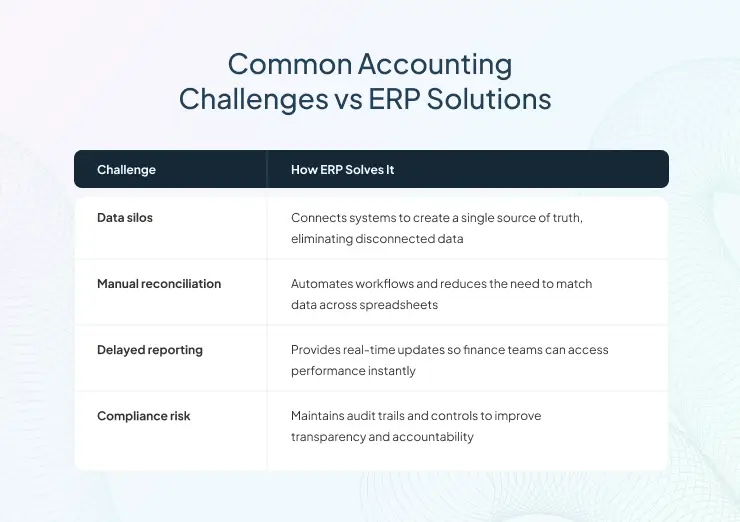
Finance teams are under constant pressure to do more than just keep the books in order. They are expected to close faster, report with precision, support forecasting, maintain compliance, and give leadership a clear view of business performance. That is a difficult job when financial data is spread across disconnected systems, reporting depends on spreadsheets, and core processes still rely on manual work.
For many organizations, that reality creates daily friction. Teams spend too much time pulling numbers from different sources, checking for errors, reconciling mismatched data, and rebuilding reports every month. What should be a clear financial picture often turns into a patchwork of systems that slows decisions and increases risk. As the business grows, those gaps become harder to manage. More entities, more transactions, and more reporting demands only add to the strain.
ERP accounting changes that by bringing financial data, workflows, and reporting into one connected system. Instead of treating accounting as a standalone function, ERP links finance with the broader business so information flows more cleanly across teams and processes. The result is better visibility, stronger control, and a more reliable foundation for decision-making.
This article breaks down what ERP accounting is, how it works in practice, and why more finance teams are moving away from traditional accounting tools.
How does ERP accounting software improve reporting, automation, and compliance?
- ERP accounting connects finance, operations, and reporting in one system
- Finance teams use ERP to automate close, consolidation, and reporting
- Real-time data improves decision-making and reduces manual errors
- Cloud ERP enables scalability, remote access, and continuous updates
- ERP replaces fragmented tools with a unified financial management system
What is ERP Accounting?
ERP accounting refers to using an enterprise resource planning system to manage financial processes such as general ledger, accounts payable, accounts receivable, and financial reporting.
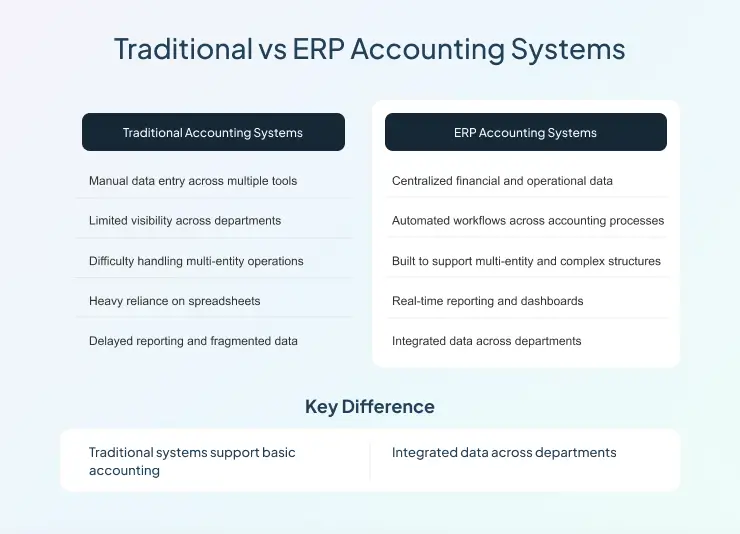
At its core, ERP accounting helps finance teams manage key functions such as:
- Recording and organizing financial transactions
- Tracking payables and receivables
- Managing the general ledger
- Generating financial reports and statements
- Supporting budgeting, forecasting, and reconciliations
Unlike standalone accounting software, ERP connects finance with other parts of the business including sales, procurement, and operations. This creates a single source of truth for financial data.
That means finance teams can work with connected information across areas like:
- Revenue and sales activity
- Purchasing and vendor spend
- Inventory and operational costs
- Project or service delivery data
- Company-wide financial performance
Instead of exporting data between systems or reconciling spreadsheets, everything updates in one place. That shift alone removes a large portion of manual effort from finance teams and makes reporting more accurate, timely, and consistent.
Financial clarity starts with connected teams

How Finance Teams Use ERP in Practice
ERP accounting comes to life in everyday finance workflows. From closing the books to tracking performance and managing compliance, ERP supports the processes finance teams rely on to keep operations accurate, timely, and aligned with business goals..
|
Finance Workflow |
How ERP Supports It |
|
Month-end close |
Automates journal entries, reconciliations, and adjustments while standardizing the close process so teams can follow consistent workflows for each cycle. |
|
Consolidates financials across subsidiaries with built-in currency and intercompany logic, reducing dependency on spreadsheets and minimizing consolidation errors. |
|
|
Budget vs actual tracking |
Compares planned vs actual performance in real time, enabling finance teams to adjust forecasts quickly based on current data. |
|
Manages revenue schedules and ensures compliance with accounting standards by automating allocation and timing across contracts and billing cycles. |
These are not theoretical benefits. They reflect how finance teams actually work when systems are integrated properly.
Pro Tip: Focus first on the finance workflows that create the most manual effort, such as close, consolidation, or reporting, then use ERP to standardize and automate them step by step.
Key Features of ERP for Accounting
ERP accounting goes beyond basic recordkeeping. It provides a set of capabilities that help finance teams automate processes, improve visibility, maintain compliance, and connect financial data with the broader business.
Automation Across Core Processes
ERP systems reduce manual input across core accounting workflows, helping finance teams work faster and with greater consistency. Instead of relying on separate tools or repetitive data entry, teams can automate routine tasks that are often time-consuming and error-prone.
Common examples include:
- Invoice processing in accounts payable
- Automated billing in accounts receivable
- Recurring journal entries
- Bank reconciliations
This improves accuracy, reduces administrative workload, and gives finance teams more time to focus on review, analysis, and planning rather than transaction processing.
Real-Time Reporting and Dashboards
With ERP accounting, financial data updates continuously as transactions move through the system. This gives finance leaders access to more timely insights without waiting for manual report compilation at the end of a reporting cycle.
Dashboards can provide visibility into areas such as:
- Cash position
- Revenue trends
- Expense breakdowns
- Profitability by business unit
This shortens the gap between financial activity and reporting, making it easier for teams to monitor performance, respond to issues early, and support better decision-making across the business.
Compliance and Audit Readiness
ERP systems maintain detailed audit trails for transactions, approvals, adjustments, and system activity. This helps organizations strengthen internal controls, improve traceability, and simplify audit preparation.
For example:
- The U.S. Securities and Exchange Commission outlines strict reporting expectations for public companies
- The Internal Revenue Service requires accurate recordkeeping for tax compliance
By centralizing records and maintaining documentation within a single system, ERP helps finance teams stay organized and better prepared for audits, reviews, and regulatory requirements.
Integrated Financial and Operational Data
One of the biggest advantages of ERP is that it connects finance with other parts of the business instead of keeping accounting data isolated. This gives finance teams a more complete view of what is happening across the organization.
ERP connects finance with functions such as:
- Inventory
- Sales
- Projects
As a result, financial reporting reflects actual business activity more accurately and with less manual reconciliation. This also improves coordination between departments and helps finance teams produce reports that are more reliable, timely, and useful for leadership.
Real-World ERP Accounting Use Cases for Growing Finance Teams
The value of ERP accounting becomes clearer when viewed through real business scenarios. As organizations grow in size, complexity, or reporting requirements, ERP helps finance teams manage that added pressure with more consistency and control.
Mid-Size Company Scaling Operations
A growing company with multiple departments often struggles with fragmented systems, inconsistent reporting, and manual handoffs between teams. ERP helps bring structure to that growth by giving finance a more connected way to manage daily operations.
- It allows teams to:
- Standardize accounting processes
- Reduce reliance on spreadsheets
- Improve reporting consistency
This makes it easier to close the books accurately, maintain better visibility across departments, and support growth without adding unnecessary complexity.
Enterprise with Global Operations
Large organizations often need to manage multiple entities, currencies, and reporting requirements across regions. Without an integrated system, consolidation can become slow, manual, and difficult to control.
- ERP systems support:
- Multi-currency transactions
- Global consolidation
- Compliance across jurisdictions
This helps enterprise finance teams produce more accurate consolidated reports, reduce reconciliation effort, and maintain stronger oversight across global operations.
SaaS Company Managing Revenue Recognition
Subscription-based businesses need to recognize revenue over time based on contract terms, billing schedules, and service delivery. Managing this manually can create errors and increase compliance risk.
- ERP systems automate:
- Deferred revenue schedules
- Contract-based billing
- Compliance with accounting standards
This gives SaaS finance teams a more reliable way to manage recurring revenue, reduce manual calculations, and stay aligned with reporting requirements.
Organizations can also refer to guidance from the U.S. Small Business Administration, which highlights the importance of structured financial management systems for growing businesses.
How Cloud ERP Improves Accounting Workflows
Cloud ERP improves accounting workflows by making ERP systems more flexible, accessible, and scalable for modern finance teams. Instead of relying on on-premises infrastructure, businesses can manage financial processes through a connected cloud environment.
Real-time access from anywhere
Cloud ERP accounting software gives finance teams access to reports, approvals, and financial data from any location, making it easier to support remote work and faster decision-making.
Scalability as the business grows
As accounting needs become more complex, cloud ERP makes it easier to add users, entities, and workflows without major system changes.
Continuous updates
Cloud ERP platforms receive regular updates without the disruption of manual upgrades, helping teams stay current with improved features and performance.
Improved collaboration
Because finance, operations, and other teams work from the same system, cloud ERP supports better coordination and more accurate reporting across the business.
Overall, cloud ERP accounting software helps finance teams work with more speed, visibility, and control.
To explore how cloud ERP capabilities come together, see Certinia’s approach to cloud ERP and financial management:
- Cloud ERP overview
- Financial management solutions
- ERP for service-based businesses
- Cloud ERP implementation insights
Key Takeaways
ERP accounting is not just an upgrade from traditional accounting software. It changes how finance teams operate.
By bringing data, workflows, and reporting into one system, ERP enables faster close cycles, better visibility, and stronger compliance.
For finance leaders evaluating their next step, the real question is not whether ERP is necessary. It is whether current systems can support the level of accuracy, speed, and insight modern businesses require.
Can your current accounting setup keep up with the demands on your finance team? See how Certinia helps organizations connect accounting, operations, and reporting in one cloud ERP platform.
Ready to simplify the path from opportunity to cash?